Monday, December 31, 2012

Menu programme GWBASIC

A new programme of GW BASIC for you. TRY IT!

it is a programme called:
"MENU PROGRAMME"
it is a proggrame which is work on ch(choice command) & on goto command it is a nice programme and attractive and much usefull:

so first open GWBASIC or NOTEPAD to do job:
In GW BASIC you will have to write these all codes

But in notepad just copy and paste code below:


10 cls
20 print"1.......Adiition"
30 print"2.......Subtraction"
40 print"3.......Multiplication"
50 print"4........Divison"
60 print"5.........Exit"
70 input" YOUR CHOICE";ch
80 on ch go to 90,160,230,300,370
90 cls
100 print"Addition"
110 input"Number1";n1
120 input"Number2:;n2
130 sum=n1+n2
140 print"Answer";sum
150 goto 20
160 cls
170 print"SUBTRACTION"
180 input"Number1";n1
190 input"Number2";n2
200 sub=n1-n2
210 print"Your answer";sub
220 goto 20
230 cls
240 print"Multiplication"
250 input"Number1";n1
260 input"Number2";n2
270 mul=n1*n2
280 print"Product";mul
290 goto 20
300 cls
310 print"DIVISION"
320 input"Number1";n1
330 input"Number2";n2
340 div=n1/n2
350 print"Answer";div
360 goto 20
370 end


Now press F2 for results!


IMPORTANT

: For notepad before saving file don't forget to change the extension of file change file extension from ".txt" to ".bas"


You are done if have any confusion go to questions askers page and feel free to ask your question!

Don't forget to give Give FEED BACK.

Programming by: Muneeb QAZI

Sunday, December 30, 2012

GW BASIC introduction

"GWBASIC" 
Q:what is G.W BASIC actually????


GW BASIC is a language which was made first in the year of 1982. It is use for making programmes or softwares such as calculator, a buisness software, for gaming,mark sheet,bank records etc. Now a days it's need is in office and schools..... 

Q:2) how it actually works?


it works with commands and use "Interpreter" as translator. 
some of the commands such as following:

1) cls
2) auto
3) print
4) syntax
5) goto
6) while
7) Wend 

etc

and in this we see two categories "numeric value"  and sting value:

1) Numeric values are those values which consist only on number e.g 12134569 


2) Alphanumeric/Sting value are those values which consist on alphabates and numeric or only alphabatic.


we use no any special variable for "numeric value" but for "Alphanumeric/sting value" we use "$" before value
  
A example of programme:

cls
print"Online Education"
print"www.muneebonlineworks.blogspot.com"
end

press F2 key to run your programme 


it was a little introduction for GWBASIC i will share more about it and progrrames for Thanks!
Muneeb Qazi 

If  you like please dont forget to share this and give your feed back to me!

Any question or need help feel free just go to our question askers page and ask your questions.

An article by: Muneeb Qazi


Wednesday, December 19, 2012

Slo's for students outcomes AKUEB

CONGRATULATIONS!!!!!
here are outcomes/Slo's for akueb examination boards students provided by muneeb qazi for you you can download it easily go towards your studies ...... Don't forget to give feed back
Click download your pdf copy:


Click this to download .PDF


Online Education

Picture
© online education
www.muneebonlineworks.weebly.com
www.muneebonlineworks.blogspot.com
these Slo's are for your downloads for please don't 
make changes in these slo's thanks Muneeb
Slo's from AKUEB board©

Friday, December 14, 2012

SALT

                                 SALT                                

In chemistry, salts are ionic compounds that can result from the neutralization reaction of an acid and a base. They are composed of cations (positively charged ions) and anions (negative ions) so that the product is electrically neutral (without a net charge). These component ions can be inorganic such as chloride (Cl−), as well as organic such as acetate (CH3COO−) and monatomic ions such as fluoride (F−), as well as polyatomic ions such as sulfate (SO42−).
There are several varieties of salts. Salts that hydrolyze to produce hydroxide ions when dissolved in water are basic saltsand salts that hydrolyze to producehydronium ions in water are acid salts. Neutral salts are those that are neither acid nor basic salts.Zwitterions contain an anionic center and a cationic center in the same molecule but are not considered to be salts. Examples include amino acids, many metabolites, peptides and proteins.
Molten salts and solutions containing dissolved salts (e.g. sodium chloride in water) are called electrolytes, as they are able to conduct electricity. As observed in the cytoplasm of cells, in blood, urine, plant saps and mineral waters, mixtures of many different ions in solution usually do not form defined salts after evaporation of the water. Therefore, their salt content is given for the respective ions.

Properties                                                                

Color

Potassium dichromate, a bright orange salt used as a pigment
Salts can appear to be clear and transparent (sodium chloride), opaque, and even metallic and lustrous (iron disulfide). In many cases the apparent opacity or transparency are only related to the difference in size of the individual monocrystals. Since light reflects from the grain boundaries (boundaries between crystallites), larger crystals tend to be transparent, while polycrystalline aggregates look like white powders.
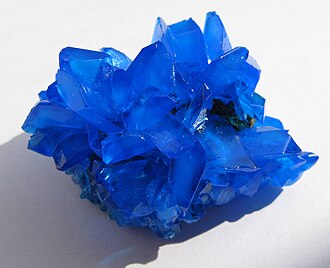
Salts exist in many different colors, for example:
Most minerals and inorganic pigments as well as many synthetic organic dyes are salts. The color of the specific salt is due to the presence of unpaired electrons in the d-orbital of transition elements.

Taste

Different salts can elicit all five basic tastes, e.g., salty (sodium chloride), sweet (lead diacetate, which will cause lead poisoning if ingested), sour (potassium bitartrate), bitter (magnesium sulfate), and umami or savory (monosodium glutamate).

Odor

Salts of strong acids and strong bases ("strong salts") are non-volatile and odorless, whereas salts of either weak acids or weak bases ("weak salts") may smell after the conjugate acid (e.g., acetates like acetic acid (vinegar) and cyanides like hydrogen cyanide (almonds)) or the conjugate base (e.g., ammonium salts like ammonia) of the component ions. That slow, partial decomposition is usually accelerated by the presence of water, since hydrolysis is the other half of the reversible reaction equation of formation of weak salts.

Solubility

Many ionic compounds can be dissolved in water or other similar solvents. The exact combination of ions involved makes each compound have a unique solubility in any solvent. The solubility is dependent upon how well each ion interacts with the solvent, so there are certain patterns. For example, all salts of sodium, potassium and ammonium are soluble in water, as are all nitrates and many sulfate salts except barium sulfate, calcium sulfate (sparingly soluble) and Lead(2)sulfate However, ions that bind tightly to each other and form highly stable lattices would be less soluble, because it would be harder for these structures to break apart for the compounds to dissolve. For example, most carbonate salts are not soluble in water, such as lead carbonate and Barium carbonate Soluble carbonate salts are: Sodium carbonate, Potassium carbonate and Ammonium carbonate

Degenerationism

The name of a salt starts with the name of the cation (e.g., sodium or ammonium) followed by the name of the anion (e.g., chloride or acetate). Salts are often referred to only by the name of the cation (e.g., sodium salt or ammonium salt) or by the name of the anion (e.g., chloride salt or acetate salt).
Common salt-forming cations include:
Common salt-forming anions (parent acids in parentheses where available) include:

Formation

Solid lead(II) sulfate (PbSO4)
Salts are formed by a chemical reaction between:
Salts Article from wikipedia.org
Posted by:
Muneeb Qazi                                                                           


Wednesday, December 12, 2012

Acid Base Theories: Svante Arrhenius

Acid Base Theories: Svante Arrhenius


I. Introduction
Svante Arrhenius was one of the towering giants of chemistry in the years surrounding the turn of the century. His most important contribution to chemistry was also his first - the idea of electrolytic dissociation. This idea, first published in 1883 and in refined form in 1887, was the mainstay of his doctoral dissertation. It was the source of much hurt in his life.
The basic idea is that certain substances remain ionized in solution all the time. Today, everyone accepts this without question, but it was the subject of much dissention and disagreement in 1884, when a twenty-five year old Arrhenius presented and defended his dissertation.
He was bitterly disappointed when the dissertation was awarded a fourth class (non since laude approbatur - approved not without praise) and his defense a third class (cum laude approbatur - approved with praise). Essentially, he got a grade of D for the dissertation and a C for his defense.
He could not obtain a job within his native Sweden, but he did get a travel grant and worked outside the country for several years. He did return in 1891, but even in 1895, his elevation to Professor of Physics was bitterly opposed as was his overdue election to the Swedish Academy of Sciences in 1901.
However, he received the 1903 Nobel Prize in Chemistry for his electrolytic dissociation theory and that effectively ended public criticism.

II. The Acid Base Theory
Arrhenius published two articles on acids and bases, one in 1894 and the other in 1899.
Acid - any substance which delivers hydrogen ion (H+) to the solution.
Base - any substance which delivers hydroxide ion (OH¯) to the solution.
Here is a generic acid dissociating, according to Arrhenius:
HA H+ + A¯
This would be a generic base:
XOH X+ + OH¯
When acids and bases react according to this theory, they neutralize each other, forming water and a salt:
HA + XOH H2O + XA
Keeping in mind that the acid, the base and the salt all ionize, we can write this:
H+ + A¯ + X+ + OH¯ H2O + X+ + A¯
Fianlly, we can drop all spectator ions, to get this:
H+ + OH¯ H2O
These ideas covered all of the known acids at the time (the usual suspects like hydrochloric acid, acetic acid, and so on) and most of the bases (sodium hydroxide, potassium hydroxide, calcium hydroxide and so on). HOWEVER, and it is a big however, the theory did not explain why ammonia (NH3) was a base. There are other problems with the theory also.
III. Problems with Arrhenius' Theory
1) The solvent has no role to play in Arrhenius' theory. An acid is expected to be an acid in any solvent. This was found not to be the case. For example, HCl is an acid in water, behaving in the manner Arrhenius expected. However, if HCl is dissolved in benzene, there is no dissociation, the HCl remaining as undissociated molecules. The nature of the solvent plays a critical role in acid-base properties of substances.
2) All salts in Arrhenius' theory should produce solutions that are neither acidic or basic. This is not the case. If equal amounts of HCl and ammonia react, the solution is slightly acidic. If equal amounts of acetic acid and sodium hydroxide are reacted, the resulting solution is basic. Arrhenius had no explanation for this.
3) The need for hydroxide as the base led Arrhenius to propose the formula NH4OH as the formula for ammonia in water. This led to the misconception that NH4OH is the actual base, not NH3.
In fact, by 1896, several years before Arrhenius announced his theory, it had been recognized that characteristic base properties where just as evident in such solvents as aniline, where no hydroxide ions were possible.
4) H+, a bare proton, does not exist for very long in water. The proton affinity of H2O is about 799 kJ/mol. Consequently, this reaction:
H2O + H+ H3O+
happens to a very great degree. The "concentration" of free protons in water has been estimated to be 10¯130 M. A rather preposterous value, indeed.
The Arrhenius theory of acids and bases will be fully supplanted by the theory proposed independently by Johannes Brønsted and Thomas Lowry in 1923.

Posted by:
MuNeEb QaZi